

Dear Customer, Partner, Suppliers,
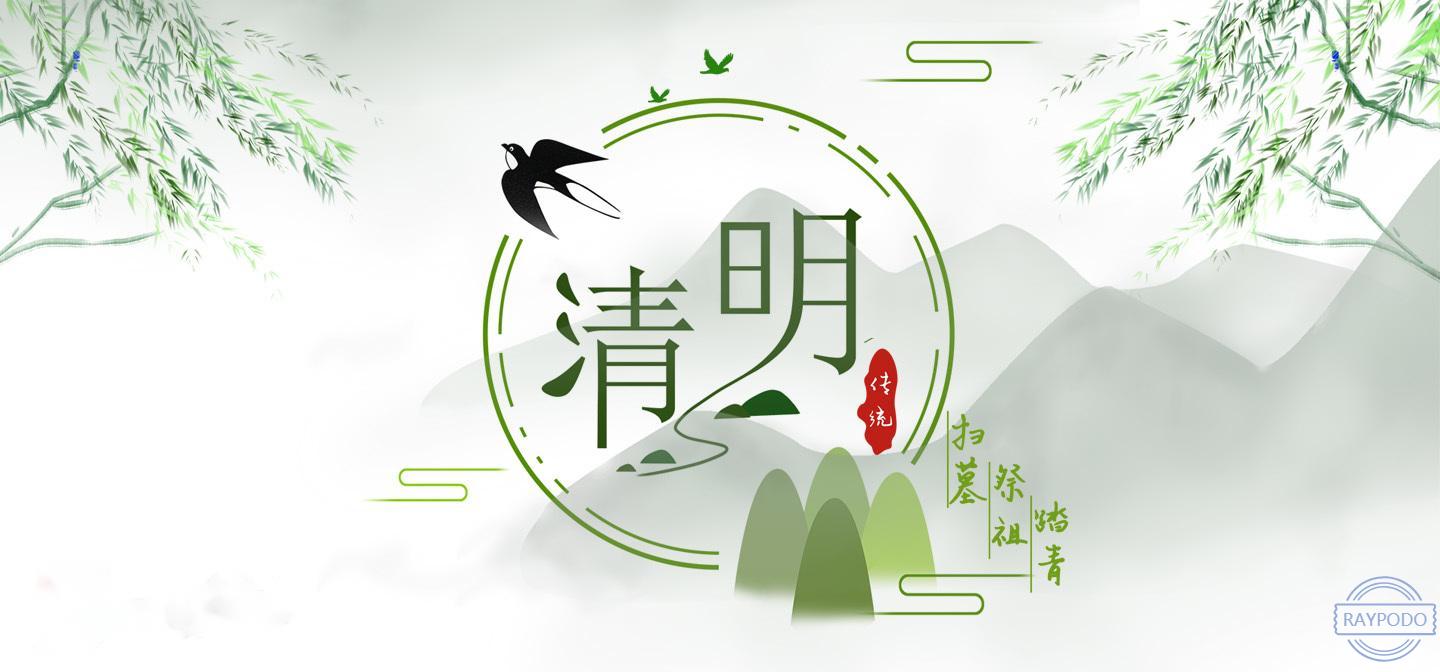
Thanks for visiting our Raypodo website. It is kindly informed that our corporate is scheduled for 3 days off, starting from Apr.3 to Apr.5, 2022, for the Ching Ming Festival.
During this period, we have no production, but we still accept the order placement and will ship out the cargo after the holiday accordingly.
- Product inquiry and technology issues, please contact info@raypodo.com
- For logistic and shipment tracking, please contact the sales contact window each.
- For the RMA issue, please send your request directly to rma@raypodo.com.
- AR and AP, please contact the accounting contact window.
Wish all the best wishes for you!
Best Regards,
RAYPODO CORPORATE
When is Ching Ming?
Ching Ming, Qingming, the Remembrance of Ancestors Day or Grave-Sweeping Day takes place on the 15th day after the Spring Equinox. This means it usually takes place on April 4th or April 5th in the western calendar.
The date of the festival is indicated on the Chinese calendar by the two characters: ching, meaning pure or clean, and ming, meaning brightness. Combined together, Ching Ming means clean and just.
This date is also indicated on traditional Japanese calendars, where their culture has a similar observance. In Korean culture, the observance is known as Hansik.
Traditions of Ching Ming
Ancestor worship is the only native religion to China. All others, including, Buddhism, Christianity, Judaism, and Islam, were imported from outside of China. (Confucianism and Taoism originated in China but are philosophies rather than religions.)
Ching Ming rituals not only include weeding of the area, cleaning of the headstone, and replacing the wilted flowers with fresh ones, but also the lighting of incense and burning of imitation paper money. The burning of the imitation money is for the deceased to use in the afterlife.
The imitations burnt are no longer limited to just money. In recent years, the burning of paper imitations of a wide variety of consumer goods has become popular. This includes all manner of objects, such as iPhones, designer handbags, houses, and sports cars.
In addition, food is laid out in front of the headstone as an offering to the spirits of the deceased.
Each family member comes in front of the headstone and bows three times with their right fist held cupped in their left hand. Some families will then eat the food at the gravesite, akin to having a picnic with their deceased relatives. It is said to bring good luck to eat the food that was offered to the deceased. Some families may also set off firecrackers to scare off evil spirits and to alert the deceased relatives that they are there to pay their respects.
Today, the responsibility to hang san or ’walk the mountain’ as visiting the cemetery is commonly known, still falls to the eldest son. Today families may be more likely to prefer simplified offerings of only incense, paper money, and flowers.
The food most commonly associated with this holiday is the qīngtuán, a glutinous rice dumpling dyed green with mugwort juice or wormwood grass. Qingtuan have traditionally been made green for centuries (qing literally means “verdant”)
The tradition of serving qingtuan at Qingming Festival is believed to date back to the Zhou dynasty more than two millennia ago when the food was a common ritual during Cold Food Festival observances that commemorated the death of nobleman Jiè Zǐtuī. Over the centuries, Cold Food Festival customs merged with those of Qingming Festival.
The Legend of Ching Ming
Tomb-Sweeping Festival dates back over 2,500 years. The legend is that around 650 BC, a man called Jie Zitui saved the life of Chong’er, a prince from the Jin principality, who was on the brink of starvation. The prince promised to reward Jie in the future. Nineteen years later, Prince Chong’er became Duke Wen. He ordered a search for Jie who had gone into hiding in the remote mountains with his mother. The duke wanted Jie to serve as one of his ministers.
Jie, who preferred to be a hermit in the Mianshan Mountain in today’s Jiexiu city of Shanxi, had no political ambitions and refused the duke’s invitation. Chong’er ordered the mountain to be burned down to force Jie out of hiding. Unfortunately, Jie did not give in and the fire ended up killing him and his mother.
To commemorate the man who saved his life the life he had just ended, Duke Wen held a memorial underneath a willow tree, which returned from its burnt state to produce lush leaves and branches, unlike poor Jie. The Duke declared that no one should eat hot food on the anniversary of the tragedy. The tradition of eating cold food on Tomb Sweeping Day continues to this day.
The day of the ceremony became Qingming, and willow branches are seen by many as a way of warding off evil spirits from family graves.



Leave a Reply
You must be logged in to post a comment.