

Are PoE wall mount tablets compatible with all types of PoE switches?
PoE wall mount tablet & PoE switch compatibility is a key issue that enterprises need to focus on when deploying PoE-based intelligent equipment systems. PoE wall mount tablets, with their integrated PoE power supply and data transmission capabilities, are widely used in various scenarios such as smart offices, intelligent buildings, and industrial monitoring. PoE switches, as the core power supply and network access equipment in the system, their compatibility with PoE wall mount tablets directly determines the stability and reliability of the entire system.
This article focuses on PoE wall mount tablet & PoE switch compatibility, exploring whether PoE wall mount tablets are compatible with all types of PoE switches. It starts with an introduction to the application background of PoE wall mount tablets and PoE switches and the importance of compatibility, then conducts in-depth technical explanation on the influencing factors of compatibility, analyzes the commercial impact of compatibility issues, lists typical application scenarios to verify the practical significance of compatibility, and finally draws conclusions and puts forward targeted compatibility selection and adaptation suggestions.
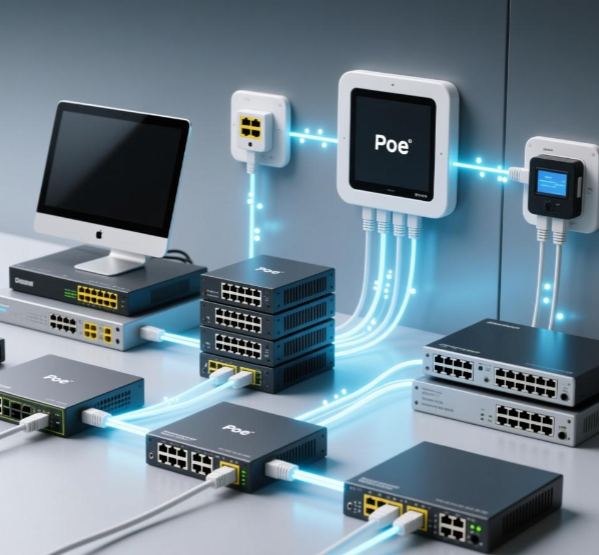
PoE wall mount tablet & PoE switch compatibility, PoE switch type adaptation, PoE power supply protocol matching
- Introduction
1.1 Application Status of PoE Wall Mount Tablets and PoE Switches
With the rapid development of the Internet of Things and intelligent construction, PoE (Power over Ethernet) technology has been widely promoted and applied. PoE wall mount tablets, as important terminal equipment in PoE systems, integrate display, computing, and communication functions, and are equipped with LCD IPS panels to ensure clear image display and wide viewing angle coverage. They are widely used in smart office reception areas, intelligent building access control management, industrial park monitoring centers and other places.
PoE switches are responsible for providing stable power supply and reliable network connection for PoE terminal equipment such as PoE wall mount tablets. According to different power supply standards and functional characteristics, PoE switches can be divided into various types. The rational matching of these switches with PoE wall mount tablets is the premise to ensure the normal operation of the system. However, in practical deployment, many enterprises will face the problem of whether PoE wall mount tablets are compatible with all types of PoE switches.
1.2 The Importance of PoE Wall Mount Tablet & PoE Switch Compatibility
PoE wall mount tablet & PoE switch compatibility directly affects the stability of the system’s power supply and network transmission. If there is incompatibility between the two, it may lead to problems such as insufficient power supply for PoE wall mount tablets, unstable network connections, or even failure to start normally. These problems will not only affect the normal use of the equipment but also may cause the interruption of related business processes.
In addition, good compatibility can improve the flexibility and scalability of the system. Enterprises can select appropriate PoE switch types according to actual needs and scene characteristics, and match them with existing or newly purchased PoE wall mount tablets to avoid the waste of equipment resources caused by incompatibility. At the same time, compatible systems are easier to maintain and upgrade, reducing the enterprise’s operation and maintenance costs and technical risks.
1.3 Research Significance of Compatibility Issues
With the continuous enrichment of PoE switch types and the increasing popularity of PoE wall mount tablets, the compatibility problem between the two has become more and more prominent. Clarifying the compatibility status between PoE wall mount tablets and different types of PoE switches, identifying the key factors affecting compatibility, and putting forward effective solution strategies are of great significance for guiding enterprises to carry out scientific equipment deployment.
This research can help enterprises avoid potential risks caused by compatibility issues during the procurement and deployment process, improve the efficiency of system construction, and ensure the stable operation of business. For equipment manufacturers, it can also provide a reference for optimizing product design and improving product compatibility, thereby enhancing market competitiveness.
- Technical Explanation
2.1 Core Factors Affecting PoE Wall Mount Tablet & PoE Switch Compatibility
The first core factor is PoE power supply protocol matching. PoE power supply protocols mainly include IEEE 802.3af, IEEE 802.3at, and IEEE 802.3bt. Different protocols specify different power supply voltages, currents, and power levels. PoE wall mount tablets and PoE switches must support the same or compatible power supply protocols to achieve normal power supply. If the protocol does not match, the PoE switch may not be able to detect the PoE wall mount tablet, or the power supply cannot meet the equipment’s operating requirements.
The second core factor is PoE switch type adaptation. PoE switches can be divided into end-span switches and mid-span switches according to the power supply mode. End-span switches integrate power supply and network switching functions, while mid-span switches need to be used with ordinary switches. PoE wall mount tablets have certain requirements for the power supply mode of PoE switches. If the type does not match, it may lead to abnormal power supply or network disconnection.
The third core factor is hardware parameter matching. This includes the matching of network interface types (such as RJ45 interface specifications), signal transmission rates, and power consumption of PoE wall mount tablets. If the network interface type of the PoE switch is inconsistent with that of the PoE wall mount tablet, it will directly affect the physical connection. The mismatch of signal transmission rates may lead to reduced network transmission efficiency or packet loss. The PoE switch’s output power that cannot meet the power consumption requirements of the PoE wall mount tablet will cause the equipment to run abnormally.
The fourth core factor is firmware and driver compatibility. The firmware of PoE wall mount tablets and PoE switches contains control logic related to power supply and network communication. If there is a conflict between the firmware versions of the two, or the driver program of the PoE wall mount tablet is incompatible with the PoE switch, it may lead to abnormal interaction between the equipment, affecting compatibility.
2.2 Analysis of Compatibility Between PoE Wall Mount Tablets and Common PoE Switch Types
For IEEE 802.3af standard PoE switches, their output power is relatively low, which is suitable for PoE wall mount tablets with low power consumption. Most entry-level PoE wall mount tablets on the market support the IEEE 802.3af protocol, so they have good compatibility with such switches. However, for high-performance PoE wall mount tablets with higher power consumption, using IEEE 802.3af standard switches may cause insufficient power supply, resulting in unstable operation of the equipment or failure to activate some high-power functions.
IEEE 802.3at standard PoE switches have higher output power and are compatible with IEEE 802.3af standard equipment. They can well meet the power consumption needs of most medium and high-performance PoE wall mount tablets. The compatibility between this type of switch and PoE wall mount tablets is relatively good, which is the mainstream choice in current enterprise deployment. However, it should be noted that some old PoE wall mount tablets that only support non-standard PoE protocols may have compatibility problems with IEEE 802.3at standard switches.
IEEE 802.3bt standard PoE switches have the highest output power, which is suitable for high-power PoE terminal equipment. For PoE wall mount tablets that support the IEEE 802.3bt protocol, this type of switch can provide sufficient power supply to ensure the stable operation of the equipment’s high-performance functions. However, for PoE wall mount tablets that only support lower-level protocols, although they can usually obtain power supply from IEEE 802.3bt standard switches, there may be problems such as low power supply efficiency, and additional configuration may be required to ensure optimal compatibility.
For mid-span PoE switches, their compatibility with PoE wall mount tablets is mainly affected by the matching of power supply voltage and current. Since mid-span switches need to be used with ordinary switches, they also need to consider the compatibility between the ordinary switch and the PoE wall mount tablet in terms of network protocols and transmission rates. Compared with end-span switches, the compatibility of mid-span switches with PoE wall mount tablets is more complex, and stricter type selection and testing are required during deployment.
2.3 Technical Methods to Verify and Ensure PoE Wall Mount Tablet & PoE Switch Compatibility
The first technical method is to conduct pre-deployment compatibility testing. Before large-scale deployment, enterprises should select a small number of PoE wall mount tablets and PoE switches of the target type to build a test environment. Test items include power supply stability, network connection status, data transmission rate, and equipment operation status under full load. Through comprehensive testing, it can be determined whether the two are compatible.
The second technical method is to check the product manual and compatibility list. Equipment manufacturers will usually provide detailed product manuals, which clearly indicate the PoE protocols, power supply parameters, and compatible equipment types supported by PoE wall mount tablets and PoE switches. Some manufacturers will also release official compatibility lists. Enterprises should carefully check these materials before purchasing to avoid incompatibility caused by blind procurement.
The third technical method is to perform firmware upgrade and configuration optimization. For PoE wall mount tablets and PoE switches with potential compatibility problems, manufacturers may release updated firmware versions to fix compatibility bugs. Enterprises can upgrade the firmware of the equipment according to the manufacturer’s guidance. At the same time, reasonable configuration of PoE switch parameters (such as power supply mode, port speed, etc.) can also improve compatibility.
The fourth technical method is to use PoE protocol converters or adapters. If there is an unavoidable compatibility problem between the existing PoE wall mount tablets and PoE switches, PoE protocol converters or adapters can be used to convert the power supply protocol or interface type to achieve normal matching between the two. However, this method will increase additional equipment costs and may affect the stability of the system to a certain extent, so it should be used as a supplementary means.
2.4 The Role of LCD IPS Panel in Reflecting Compatibility Problems
Although the LCD IPS panel of the PoE wall mount tablet does not directly participate in the compatibility interaction between the PoE switch, it can intuitively reflect the compatibility problems between the two. If there is incompatibility leading to insufficient power supply, the LCD IPS panel may appear abnormal phenomena such as dim display, screen flicker, or automatic dimming failure.
If the compatibility problem affects the network transmission, the data displayed on the LCD IPS panel (such as real-time monitoring images, network status information) may appear delayed, stuck, or blurred. These abnormal phenomena can help technical personnel quickly judge whether there is a compatibility problem between the PoE wall mount tablet and the PoE switch, and provide clues for subsequent troubleshooting.
- Commercial Impact
3.1 Impact on System Deployment Efficiency and Cost
Good PoE wall mount tablet & PoE switch compatibility can significantly improve the efficiency of system deployment. Enterprises can smoothly complete the connection and debugging between equipment, avoid the time cost wasted due to compatibility problems such as equipment replacement, re-purchasing, and repeated debugging. At the same time, compatible equipment can make full use of existing resources, reduce the investment in new equipment, and control the overall deployment cost.
On the contrary, if there is incompatibility between the two, it will seriously affect the deployment progress. Enterprises may need to re-select equipment, return or exchange goods, which will not only delay the project progress but also increase additional procurement costs and labor costs. In severe cases, it may even lead to the suspension of the entire system construction project, causing greater economic losses.
3.2 Impact on System Operation Stability and Maintenance Costs
Compatible PoE wall mount tablets and PoE switches can ensure the stable operation of the system, reduce the frequency of equipment failures caused by compatibility issues. This will significantly reduce the enterprise’s operation and maintenance costs. Technical personnel do not need to spend a lot of time dealing with faults such as abnormal power supply and network disconnection caused by incompatibility, and can focus more on daily system optimization and management.
If the compatibility is poor, the system will often have various faults, which will increase the workload of operation and maintenance personnel. The maintenance of incompatible equipment may require special technical means or the replacement of key components, which will increase the maintenance cost. In addition, frequent faults will affect the continuity of business operations, leading to indirect economic losses.
3.3 Impact on Enterprise Business Development and Market Competitiveness
For enterprises that rely on PoE-based intelligent systems to carry out core businesses (such as intelligent monitoring companies, smart building operation and maintenance enterprises), the stability of the system directly affects business development. The stable operation of the system ensured by good compatibility can improve business efficiency and service quality, enhance customer satisfaction.
In the market competition, enterprises with stable and efficient intelligent systems are more likely to gain the trust of customers and occupy an advantageous position. On the contrary, if the system often has problems due to compatibility issues, it will damage the enterprise’s brand image and affect customer cooperation intentions. In the long run, it will restrict the sustainable development of the enterprise and reduce market competitiveness.
3.4 Impact on Equipment Upgrade and Expansion Flexibility
Good PoE wall mount tablet & PoE switch compatibility provides sufficient flexibility for the subsequent upgrade and expansion of the system. When the enterprise’s business develops and needs to increase the number of PoE wall mount tablets or upgrade to higher-performance equipment, it can directly select compatible PoE switches or expand the existing switch capacity without replacing the entire system.
If the initial equipment has poor compatibility, the upgrade and expansion of the system will face great restrictions. Enterprises may need to replace a large number of existing equipment to ensure the compatibility of the new and old equipment, which will increase the upgrade cost and affect the continuity of business. This will make the enterprise lag behind in the process of digital transformation and intelligent upgrading.
- Typical Use Cases
4.1 Smart Office Building Deployment Scenario
In the smart office building scenario, PoE wall mount tablets are widely used in areas such as elevator lobbies, meeting room entrances, and office area corridors for displaying office information, accessing control management, and calling services. The PoE switches deployed in this scenario are mostly end-span switches supporting IEEE 802.3at protocol to meet the power supply needs of multiple PoE wall mount tablets at the same time.
During the deployment process, if the selected PoE wall mount tablets are compatible with the IEEE 802.3at protocol PoE switches, the equipment can be quickly connected and debugged, and the system can run stably. The LCD IPS panel of the PoE wall mount tablet can clearly display various information, and the network transmission is smooth. If the PoE wall mount tablets only support the IEEE 802.3af protocol, but the PoE switches do not have backward compatibility, it may lead to insufficient power supply for the tablets, resulting in dim screen display or failure to start the access control function.
4.2 Industrial Park Monitoring Scenario
In the industrial park monitoring scenario, PoE wall mount tablets are used as monitoring terminals to display real-time monitoring images of each area and receive alarm information. The PoE switches in this scenario need to have high stability and anti-interference ability, and most of them are industrial-grade PoE switches supporting IEEE 802.3bt protocol to meet the power consumption needs of high-performance PoE wall mount tablets and ensure 24-hour continuous operation.
Compatibility between the two is crucial in this scenario. If there is a protocol mismatch, the PoE wall mount tablet may not be able to obtain stable power supply, resulting in intermittent monitoring images or loss of alarm information. If the signal transmission rate does not match, the monitoring images displayed on the LCD IPS panel may be delayed or stuck, affecting the real-time monitoring effect and the efficiency of emergency response.
4.3 Smart Retail Store Deployment Scenario
In the smart retail store scenario, PoE wall mount tablets are used for commodity information inquiry, promotion information display, and cash register auxiliary functions. The PoE switches deployed in the store are mostly small and medium-sized end-span switches, which need to be compatible with the PoE wall mount tablets while connecting other network equipment (such as cash registers, surveillance cameras).
If the PoE wall mount tablets and PoE switches are incompatible, it may lead to abnormal display of commodity information or failure of the cash register auxiliary function, affecting the normal operation of the store. For example, if the PoE switch’s output power cannot meet the power consumption requirements of the PoE wall mount tablet, the LCD IPS panel may flicker when displaying high-definition promotion videos, affecting the customer’s viewing experience and the effect of promotion activities.
4.4 Mid-Span Switch Matching Scenario in Old Building Renovation
In the old building renovation scenario, due to the existing ordinary network switches, enterprises often choose mid-span PoE switches to realize PoE power supply for newly added PoE wall mount tablets. This scenario has higher requirements for the compatibility between mid-span PoE switches, ordinary switches, and PoE wall mount tablets.
If the mid-span PoE switch is incompatible with the ordinary switch, it may lead to network disconnection between the PoE wall mount tablet and the background system. If the mid-span PoE switch is incompatible with the PoE wall mount tablet in terms of power supply protocol, it may cause the tablet to fail to start. This will affect the progress of the old building renovation project and the normal use of intelligent functions after renovation.
- Conclusion
5.1 Summary of PoE Wall Mount Tablet & PoE Switch Compatibility Status
PoE wall mount tablets are not compatible with all types of PoE switches. Their compatibility is affected by multiple factors such as PoE power supply protocol matching, PoE switch type adaptation, hardware parameter matching, and firmware and driver compatibility. Different types of PoE switches (such as IEEE 802.3af, IEEE 802.3at, IEEE 802.3bt, end-span, mid-span) have different compatibility performances with PoE wall mount tablets.
Generally speaking, PoE wall mount tablets and PoE switches that support the same or compatible IEEE standard protocols have better compatibility. End-span PoE switches have simpler compatibility requirements than mid-span switches. However, due to the differences in hardware parameters and firmware versions of different brands and models of equipment, even if they support the same protocol, there may be individual compatibility problems. Therefore, it is impossible to simply assume that all PoE wall mount tablets are compatible with all types of PoE switches.
5.2 Suggestions for Ensuring PoE Wall Mount Tablet & PoE Switch Compatibility
For enterprises, the first step is to do a good job in pre-purchase investigation. Before purchasing PoE wall mount tablets and PoE switches, carefully study the product manuals, check the supported protocols, power parameters, and compatibility lists. It is recommended to give priority to purchasing equipment from the same brand or equipment that has been verified to be compatible to reduce compatibility risks.
The second step is to carry out pre-deployment compatibility testing. Select a small number of sample equipment to build a test environment, conduct comprehensive tests on power supply, network transmission, and equipment operation status, and confirm that there is no compatibility problem before large-scale deployment. For mid-span switch deployment scenarios, special attention should be paid to the compatibility test between the mid-span switch, ordinary switch, and PoE wall mount tablet.
The third step is to strengthen the daily maintenance and firmware management of the equipment. Regularly check the operation status of PoE wall mount tablets and PoE switches, and pay attention to the firmware update information released by the manufacturer. For equipment with potential compatibility problems, timely upgrade the firmware to ensure the stability of compatibility. At the same time, establish a complete equipment operation and maintenance record to facilitate the tracking and handling of compatibility problems.
5.3 Suggestions for Equipment Manufacturers
Manufacturers should strengthen the compatibility design of products. When developing PoE wall mount tablets and PoE switches, fully consider the compatibility with mainstream protocols and equipment types on the market, and conduct in-depth compatibility testing. For PoE switches, it is recommended to enhance backward compatibility to support PoE wall mount tablets with lower-level protocols.
Manufacturers should provide detailed compatibility information for users. Clearly indicate the compatible equipment models, protocols, and parameters in the product manual, and release official compatibility lists in a timely manner. For users who encounter compatibility problems, provide professional technical support and solutions, such as firmware upgrade packages and configuration guides.
In addition, manufacturers can strengthen technical exchanges and cooperation. PoE wall mount tablet manufacturers and PoE switch manufacturers can establish cooperative relations to carry out joint testing and verification, improve the compatibility between products. At the same time, participate in the formulation and promotion of industry standards to promote the standardized development of PoE technology and reduce compatibility problems caused by non-standard products.
5.4 Final Takeaways
PoE wall mount tablet & PoE switch compatibility is a key link in the construction of PoE-based intelligent systems. It directly affects the efficiency of system deployment, the stability of operation, the cost of maintenance, and the development of enterprise business. PoE wall mount tablets are not compatible with all types of PoE switches, and their compatibility is restricted by multiple technical factors.
Enterprises must attach great importance to compatibility issues, do a good job in pre-purchase investigation and pre-deployment testing, and strengthen daily equipment maintenance to ensure the compatibility and stable operation of the system. Equipment manufacturers should optimize product compatibility design, provide detailed compatibility information and professional technical support. Only through the joint efforts of enterprises and manufacturers can the potential risks of compatibility issues be effectively avoided, and the advantages of PoE technology be fully exerted to promote the healthy development of the intelligent equipment industry.
Trusted PoE Wall Mount Tablet & PoE Switch Compatibility Guide 2



Leave a Reply
You must be logged in to post a comment.