

How to solve the problem of operating system lag in long-term running wall mount tablets?
Long-running tablet OS lag solution is a key issue concerned by enterprises in the process of using wall mount tablets. Wall mount tablets are widely used in various indoor scenarios such as enterprise office, access control management and information release. Most of these scenarios require long-term continuous operation of the equipment. Operating system lag caused by long-term running will seriously affect the work efficiency and user experience, and even lead to business interruption in severe cases. Exploring effective solutions to this problem is of great significance for ensuring the stable operation of wall mount tablets and improving the efficiency of enterprise business processing.
This article focuses on long-running tablet OS lag solution, starting from the causes of operating system lag in long-term running wall mount tablets, deeply analyzes the technical principles and implementation paths of relevant solutions, explores the commercial impact brought by solving the lag problem, lists typical application scenarios, and finally draws conclusions and puts forward targeted suggestions to provide professional reference for enterprise operation and maintenance personnel, product R&D personnel and relevant industry practitioners.
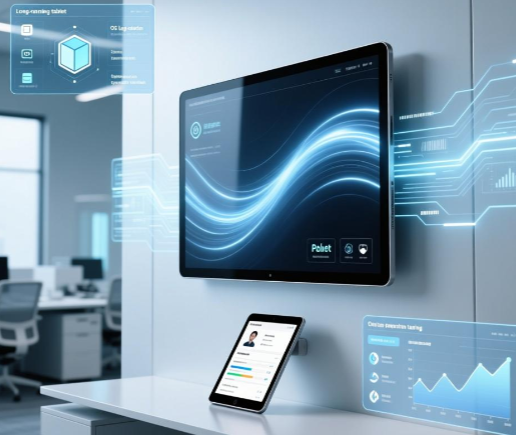
Long-running tablet OS lag solution, System resource optimization, Continuous operation tuning
- Introduction
1.1 Operation Characteristics of Long-Term Running Wall Mount Tablets
Wall mount tablets in long-term running state have obvious operation characteristics different from intermittent use equipment. First, they have the characteristics of continuous high load operation. Most wall mount tablets need to run 24 hours a day and 7 days a week, continuously undertaking tasks such as data processing, information display and command execution. The long-term high load operation makes the operating system face continuous pressure of resource occupation and data processing.
Second, the software and hardware environment is relatively fixed. After the wall mount tablets are put into use, their operating system, application software and hardware configuration are basically fixed, and there is little possibility of frequent updates and replacements. This fixed environment makes the potential problems of the operating system accumulate continuously during long-term operation, which is easy to trigger lag. Finally, the operation and maintenance intervention is relatively limited. In many application scenarios, wall mount tablets are deployed in decentralized locations, and it is difficult for operation and maintenance personnel to carry out real-time monitoring and maintenance, which makes it difficult to find and solve the lag problem in time.
1.2 Core Position of Long-Running Tablet OS Lag Solution in Equipment Operation
Long-running tablet OS lag solution occupies a core position in ensuring the stable operation of wall mount tablets. The operating system is the core of the wall mount tablet, which manages the hardware resources and coordinates the operation of various application software. Once the operating system lags, it will affect the normal operation of all functions of the tablet, resulting in slow response of the interface, delayed data processing and even unresponsive operation.
In scenarios that require real-time data processing and rapid response, such as access control management and production scheduling, the lag of the operating system may lead to serious consequences such as business interruption and safety risks. Therefore, formulating and implementing effective long-running tablet OS lag solution is the key to ensuring the reliability and usability of wall mount tablets, and is an important part of enterprise equipment management.
1.3 Current Status of Enterprise Response to Operating System Lag in Long-Term Running Wall Mount Tablets
At present, enterprises have different responses to the problem of operating system lag in long-term running wall mount tablets, and there are still many deficiencies. Some enterprises adopt a passive response strategy, only dealing with the lag problem after it occurs, which often leads to the expansion of the impact of the problem and affects the normal progress of business. Some enterprises blindly carry out system upgrades and hardware replacements, ignoring the root causes of lag, resulting in increased operation and maintenance costs and poor solution effects.
In addition, many enterprise operation and maintenance personnel lack professional knowledge about the causes of operating system lag and solution methods, and it is difficult to formulate targeted solutions. The lack of effective monitoring tools and early warning mechanisms also makes it difficult for enterprises to find the signs of lag in time, resulting in the lag problem becoming more and more serious. Therefore, it is urgent to systematically explore long-running tablet OS lag solution, help enterprises establish a proactive prevention and control system, and fundamentally solve the lag problem.
1.4 Significance of Exploring Long-Running Tablet OS Lag Solution
Exploring how to solve the problem of operating system lag in long-term running wall mount tablets is of great practical significance for enterprises and the industry. For enterprises, it can help reduce the impact of lag on business, improve the efficiency of equipment use, reduce operation and maintenance costs, and ensure the stable operation of core business. For product R&D personnel, it can provide a clear direction for the optimization of wall mount tablets, guide them to improve the system stability and long-term operation performance of products.
For the entire industry, it is conducive to promoting the improvement of the technical level of wall mount tablets, standardizing the solution process of related problems, and promoting the healthy development of the industry. In addition, this exploration can also enrich the theoretical system of embedded operating system optimization, providing important theoretical support for the development of related fields such as industrial control and intelligent terminals.
- Technical Explanation
2.1 Main Causes of Operating System Lag in Long-Term Running Wall Mount Tablets
The operating system lag of long-term running wall mount tablets is caused by a variety of factors, which can be mainly divided into software factors and hardware factors. From the perspective of software factors, the continuous accumulation of system garbage is an important cause. During the long-term operation of the operating system, a large amount of temporary files, cache files and invalid registry entries will be generated. If these garbage files are not cleaned up in time, they will occupy a lot of storage space and system resources, leading to slow system operation.
The memory leak of application software is another important software factor. Some application software has defects in the design process, which will continuously occupy memory resources during operation and not release them in time. With the extension of running time, the available memory of the system becomes less and less, resulting in lag. From the perspective of hardware factors, the aging of hardware components and insufficient hardware performance will also lead to system lag. For example, the decline in the reading and writing speed of the storage device will slow down the system’s access to files, and the insufficient processing capacity of the processor will make it difficult to respond to multiple tasks at the same time.
2.2 Technical Principles of Long-Running Tablet OS Lag Solution
Long-running tablet OS lag solution is based on the technical principles of system resource management optimization, software defect repair and hardware performance improvement. System resource optimization is the core of solving lag problems, which mainly includes memory resource management, storage resource management and CPU resource management. By optimizing the allocation mechanism of system resources, ensuring that each task can obtain sufficient resources, and avoiding resource competition and waste, the operation efficiency of the system can be improved.
For software defects such as memory leaks, the technical principle of the solution is to find and repair the defects through software testing and code optimization, ensure that the application software can release resources normally during operation. For hardware factors, the solution is based on the principle of hardware performance matching and upgrading, selecting hardware components with stable performance and sufficient capacity, and carrying out targeted upgrades for aging hardware to improve the overall performance of the equipment. In addition, the establishment of real-time monitoring and early warning mechanisms is also an important part of the solution, which can find the signs of lag in time and take preventive measures.
2.3 Specific Implementation Paths of Long-Running Tablet OS Lag Solution
The specific implementation paths of long-running tablet OS lag solution include software optimization, hardware improvement and operation and maintenance management strengthening. In terms of software optimization, the first is to carry out regular system garbage cleaning, set up automatic cleaning tasks, and timely clear temporary files, cache files and other garbage. The second is to optimize the application software, repair memory leak defects, and reduce the occupation of system resources by the software.
The third is to optimize the operating system configuration, close unnecessary background services and startup items, and reduce the burden of the system. In terms of hardware improvement, it is necessary to select high-quality hardware components, such as high-speed solid-state drives and high-performance processors, to improve the basic performance of the equipment. For the wall mount tablets that have been put into use, targeted hardware upgrades can be carried out according to the actual operation situation, such as expanding memory and replacing high-speed storage devices.
In terms of operation and maintenance management, it is necessary to establish a real-time monitoring system to monitor the resource occupation of the operating system and the operation status of the application software, and set up early warning thresholds. Once the indicators exceed the thresholds, early warning signals will be sent to remind operation and maintenance personnel to deal with them in time.
2.4 Relationship Between Long-Running Tablet OS Lag Solution and System Resource Optimization
Long-running tablet OS lag solution and system resource optimization are closely related, and system resource optimization is an important part of the lag solution. System resource optimization aims to improve the utilization efficiency of system resources and avoid resource waste and competition by adjusting the allocation and management mode of system resources such as memory, CPU and storage.
Many causes of operating system lag are directly related to unreasonable resource allocation and low resource utilization. For example, insufficient memory allocation leads to frequent memory swapping of the system, and excessive CPU resource occupation leads to slow task processing. Therefore, through system resource optimization, the root causes of many lag problems can be solved, and the operation efficiency and stability of the operating system can be improved. Long-running tablet OS lag solution takes system resource optimization as the core means, and combines with other solutions to form a comprehensive solution system.
2.5 Technical Requirements for Implementing Long-Running Tablet OS Lag Solution
Implementing long-running tablet OS lag solution requires certain technical support and meets corresponding technical requirements. First, in terms of software technology, it is necessary to master the optimization methods of the operating system, be familiar with the resource management mechanism of the system, and have the ability to test and repair application software defects. For example, when optimizing the Android operating system, it is necessary to be familiar with the memory management mechanism of the system and know how to adjust the memory allocation parameters.
Second, in terms of hardware technology, it is necessary to understand the performance characteristics of various hardware components, be able to select hardware that matches the system requirements, and have the ability to carry out hardware installation and upgrade. Third, in terms of monitoring technology, it is necessary to master the use of monitoring tools, be able to collect and analyze the operating data of the system in real time, and set up scientific early warning thresholds. In addition, it is also necessary to have the ability of system integration, and integrate software optimization, hardware improvement and monitoring management to form a coordinated and efficient solution system.
2.6 Relationship Between Long-Running Tablet OS Lag Solution and Continuous Operation Tuning
Long-running tablet OS lag solution and continuous operation tuning complement each other and jointly ensure the long-term stable operation of the wall mount tablet operating system. Continuous operation tuning refers to the continuous monitoring and adjustment of the operating system and application software during the long-term operation of the equipment, so as to keep the system in the best operation state.
Long-running tablet OS lag solution provides a set of targeted solutions for the lag problem, while continuous operation tuning can find new potential lag problems in time through real-time monitoring, and adjust the solution strategy according to the changes of the operation environment. For example, with the increase of application software functions, the resource occupation of the system may change. Through continuous operation tuning, the resource allocation can be adjusted in time to avoid lag. Therefore, combining long-running tablet OS lag solution with continuous operation tuning can form a closed-loop management of the system operation state, fundamentally solving the lag problem.
- Commercial Impact
3.1 Impact on Wall Mount Tablet Manufacturers
Long-running tablet OS lag solution has an important impact on the product R&D strategy and market competition of wall mount tablet manufacturers. Manufacturers that can provide effective lag solutions and integrate them into product design can improve the long-term operation stability of products, enhance user satisfaction, and gain more market recognition. For example, manufacturers that optimize the operating system and select high-quality hardware components to reduce the possibility of lag are more likely to win orders from enterprises with high requirements for equipment stability.
In terms of product R&D, manufacturers need to increase investment in the research of operating system optimization technology, strengthen the testing of product long-term operation performance, and continuously improve the long-running tablet OS lag solution. This may increase the R&D cost in the short term, but in the long run, it can enhance the core competitiveness of products, improve the brand image, and bring more economic benefits. In addition, manufacturers can take the excellent long-term operation performance of products as a core selling point, distinguish their products from competitors, and form a unique market advantage.
3.2 Impact on Enterprise Operation and Maintenance Costs
Implementing effective long-running tablet OS lag solution can help enterprises significantly reduce operation and maintenance costs. On the one hand, solving the lag problem can reduce the frequency of equipment failures, reduce the workload of operation and maintenance personnel, and save the labor cost of operation and maintenance. On the other hand, proactive prevention and control through the solution can avoid the expansion of the impact of lag problems, reduce the cost of business interruption and equipment maintenance caused by lag.
For example, through regular system garbage cleaning and resource optimization, the probability of system lag can be reduced, avoiding the cost of manual processing of lag faults and the economic loss caused by business suspension. In addition, the long-running tablet OS lag solution based on system resource optimization can improve the utilization efficiency of equipment resources, avoid the waste of resources caused by unreasonable configuration, and reduce the cost of hardware upgrades caused by insufficient resource allocation.
3.3 Impact on Enterprise Business Efficiency and User Experience
Long-running tablet OS lag solution directly affects enterprise business efficiency and user experience. The stable operation of the wall mount tablet operating system ensures the continuous and efficient progress of business processes, avoiding delays and interruptions caused by lag. For example, in the enterprise access control management scenario, the wall mount tablet with no lag can quickly complete the employee identity verification, improving the efficiency of personnel entry and exit.
In terms of user experience, the smooth operation of the system makes the operation of the tablet more convenient and fast, reducing the user’s waiting time and improving the user’s satisfaction. For example, in the information release scenario of the enterprise lobby, the smoothly running wall mount tablet can quickly display the latest information, giving visitors a good impression. On the contrary, the lagging system will make users feel frustrated, affect the use experience, and even damage the enterprise’s image.
3.4 Impact on the Development of the Intelligent Terminal Industry
The widespread attention to long-running tablet OS lag solution has promoted the transformation and upgrading of the intelligent terminal industry. It has guided manufacturers to shift their focus from simply pursuing hardware performance to paying more attention to the long-term operation stability and user experience of products, promoting the optimization of the industrial structure. Manufacturers are more willing to invest in the research and development of operating system optimization technology and long-term operation testing technology, which has improved the overall technical level of the industry.
At the same time, the demand for long-running tablet OS lag solution has also driven the development of related supporting industries, such as system optimization software developers, intelligent monitoring tool manufacturers and operation and maintenance service providers. The development of these industries has provided better technical support and service guarantee for the application of wall mount tablets, promoting the healthy and sustainable development of the entire intelligent terminal industry. In addition, the emphasis on solving the lag problem has also promoted the formulation and improvement of industry standards for intelligent terminals, standardizing market competition and protecting the legitimate rights and interests of enterprises and users.
- Typical Use Cases
4.1 Enterprise Office Attendance and Access Control Scenario
In the enterprise office attendance and access control scenario, wall mount tablets need to run continuously for a long time to undertake tasks such as employee identity verification, attendance data collection and access permission management. Operating system lag will lead to slow response of identity verification, delayed data collection, and even failure to complete verification, seriously affecting the normal office order of the enterprise.
Implementing long-running tablet OS lag solution can effectively solve these problems. Through regular system garbage cleaning, optimizing application software and strengthening resource management, the stable operation of the system can be ensured. For example, setting up automatic cleaning tasks to clear the cache files generated by the attendance system in time, and optimizing the attendance software to avoid memory leaks. This can ensure that the wall mount tablet responds quickly to the verification request, improve the efficiency of attendance and access control management, and ensure the normal progress of enterprise office work.
4.2 Industrial Workshop Production Scheduling Scenario
In the industrial workshop production scheduling scenario, wall mount tablets are installed on the production line to display production data in real time, receive scheduling commands and feed back production status. These tablets need to run continuously in a high-load state for a long time, and the requirements for system stability are extremely high. Operating system lag will lead to delayed display of production data, slow execution of scheduling commands, and even affect the normal progress of production.
Adopting long-running tablet OS lag solution is crucial to ensure the stable operation of the production scheduling system. On the software side, optimize the production scheduling software to reduce resource occupation, and configure the operating system to close unnecessary background services. On the hardware side, select high-performance processors and high-speed solid-state drives to improve the data processing and reading/writing speed of the system. At the same time, establish a real-time monitoring system to monitor the system resource occupation in real time. Once the lag sign is found, timely adjust the resource allocation to ensure the real-time and accuracy of production scheduling, and avoid production stagnation caused by system lag.
4.3 Commercial Building Information Release Scenario
In the commercial building information release scenario, wall mount tablets are installed in the lobby, corridor and other public areas to display building introduction, merchant information, public notice and other content. These tablets need to run continuously for a long time to ensure the continuous release of information. Operating system lag will lead to stuck screen display, delayed information update, and affect the information transmission effect and the image of the commercial building.
Implementing long-running tablet OS lag solution can ensure the smooth operation of the information release system. For example, optimize the information release software to reduce memory occupation, set up regular system restart tasks to release system resources, and select hardware components with stable performance to improve the long-term operation stability of the equipment. This can ensure that the wall mount tablet displays information smoothly, updates information in a timely manner, and provides visitors and merchants with good information inquiry experience.
4.4 Hospital Ward Call and Information Query Scenario
In the hospital ward call and information query scenario, wall mount tablets are installed at the head of the bed and in the corridor to provide services such as patient call, medical information query and hospital regulation browsing. These tablets need to run continuously for a long time, and the timeliness of system response is directly related to the quality of medical services. Operating system lag will lead to delayed response of the call system, affecting the timely treatment of patients.
Long-running tablet OS lag solution can effectively ensure the timely response of the system. Through system resource optimization, such as allocating sufficient memory for the call system, and optimizing the call software to avoid resource occupation. At the same time, establish a real-time monitoring mechanism for the call system. Once the system response speed slows down, timely clean up system garbage and adjust resource allocation. This can ensure that the patient’s call request is responded to in time, improve the efficiency of medical service, and enhance the patient’s medical experience.
4.5 Financial Institution Business Handling Scenario
In the financial institution business handling scenario, wall mount tablets are used for customers to query account information, handle business appointments and understand financial products. These tablets need to run continuously for a long time, and the requirements for system stability and security are high. Operating system lag will lead to slow business handling, affect customer experience, and even bring potential risks to financial data security.
Implementing long-running tablet OS lag solution is of great significance for ensuring the smooth handling of financial business. On the one hand, optimize the operating system and business handling software to improve the system response speed and ensure that customers can quickly complete the query and appointment. On the other hand, strengthen the monitoring of system resources and the security of financial data. While solving the lag problem, ensure the security of data. This can improve customer satisfaction, enhance the image of financial institutions, and ensure the stable operation of financial business.
- Conclusion
5.1 Summary of Long-Running Tablet OS Lag Solution
The problem of operating system lag in long-term running wall mount tablets is a comprehensive problem caused by multiple factors such as software, hardware and operation and maintenance management. Long-running tablet OS lag solution is a systematic project that integrates software optimization, hardware improvement and operation and maintenance management strengthening. Software optimization is the core, including system garbage cleaning, application software repair and system configuration adjustment.
Hardware improvement is the foundation, which ensures the basic performance of the system by selecting high-quality components and carrying out targeted upgrades. Operation and maintenance management strengthening is the guarantee, which finds and solves potential problems in time through real-time monitoring and early warning. Only by integrating these three aspects can we fundamentally solve the lag problem and ensure the long-term stable operation of the wall mount tablet operating system.
5.2 Suggestions for Wall Mount Tablet Manufacturers
For wall mount tablet manufacturers, first of all, they should take long-running tablet OS lag solution as an important part of product R&D, increase investment in operating system optimization technology research, and integrate lag prevention and solution measures into product design. For example, optimize the system resource allocation mechanism, select high-quality hardware components with stable performance, and carry out strict long-term operation testing on products to ensure that the products have excellent long-term operation stability.
Secondly, manufacturers should provide personalized lag solutions for different application scenarios, according to the different operation characteristics and requirements of wall mount tablets in different scenarios, develop targeted software and hardware configuration schemes. In addition, manufacturers should strengthen technical support for enterprises, provide operation and maintenance training and technical guidance for enterprise operation and maintenance personnel, help them master the use method of lag solutions, and improve the effect of solution implementation. Finally, manufacturers should pay attention to the feedback of market and users, continuously optimize and upgrade products according to the new problems and needs in the process of use, and improve the ability to solve lag problems.
5.3 Suggestions for Enterprise Operation and Maintenance Personnel
For enterprise operation and maintenance personnel, first of all, they should establish a correct understanding of long-running tablet OS lag solution, and realize that solving the lag problem requires a combination of proactive prevention and reactive treatment. They should formulate a comprehensive operation and maintenance plan, including regular system garbage cleaning, application software testing, hardware inspection and other tasks, and strictly implement the plan to reduce the occurrence of lag problems.
Secondly, operation and maintenance personnel should strengthen the learning of professional knowledge, master the technical principles and implementation methods of long-running tablet OS lag solution, and improve their ability to solve practical problems. They should be familiar with the use of monitoring tools, set up scientific early warning thresholds, and establish a rapid response mechanism. Once the lag problem occurs, they can quickly locate the cause and take targeted solutions. In addition, operation and maintenance personnel should collect and sort out the data of lag problems, analyze the rules and characteristics of lag, and provide data support for the optimization of the solution.
5.4 Suggestions for Enterprise Procurement Personnel
For enterprise procurement personnel, first of all, they should pay attention to the long-term operation stability of wall mount tablets when purchasing, and take the long-running tablet OS lag solution provided by manufacturers as an important reference index for product selection. They should not only pay attention to the hardware performance parameters of products, but also understand the software optimization measures and long-term operation testing results of products.
Secondly, procurement personnel should communicate with manufacturers in detail, understand the technical details and implementation effect of the lag solution, and select products that can meet the actual operation needs of the enterprise. They can conduct on-site tests on products, simulate the long-term operation environment of the enterprise, and verify the stability of products. In addition, procurement personnel should sign clear after-sales service agreements with manufacturers, requiring manufacturers to provide timely technical support and solution updates when lag problems occur, ensuring the long-term stable operation of equipment.
5.5 Future Development Trend of Long-Running Tablet OS Lag Solution
In the future, with the continuous development of intelligent terminal technology and the increasing complexity of application scenarios, long-running tablet OS lag solution will develop towards intelligence, automation and integration. On the one hand, intelligent optimization technology will be widely used. With the help of artificial intelligence and big data technology, the system can automatically analyze the operation state and resource occupation of the equipment, predict potential lag problems, and carry out automatic optimization and adjustment without manual intervention.
On the other hand, the integration of solutions will be further improved. Long-running tablet OS lag solution will be integrated with equipment management, security monitoring and other systems to form a comprehensive intelligent management platform, realizing the unified management and optimization of equipment. In addition, the lightweight and efficient optimization technology will become a research focus. While ensuring the optimization effect, the resource occupation of the optimization program itself will be reduced, and the impact on the normal operation of the system will be minimized.
Manufacturers, enterprises and relevant research institutions should work together to promote the innovation and development of long-running tablet OS lag solution technology. Manufacturers should increase R&D investment, develop intelligent and automated optimization technologies, and improve the performance and effect of solutions. Enterprises should put forward more clear requirements for lag solutions according to the actual operation needs, and promote the upgrading of solutions through market demand. Research institutions should strengthen theoretical research and technical innovation, provide technical support for the development of the industry. Only in this way can the intelligent terminal industry develop in a healthier and more sustainable direction, providing better products and services for enterprise digital transformation.
Proven Long-Running Tablet OS Lag Solution Guide 5


Leave a Reply
You must be logged in to post a comment.