

What are the advantages of Android 11 vs Android 13 for commercial PoE wall mount tablets?
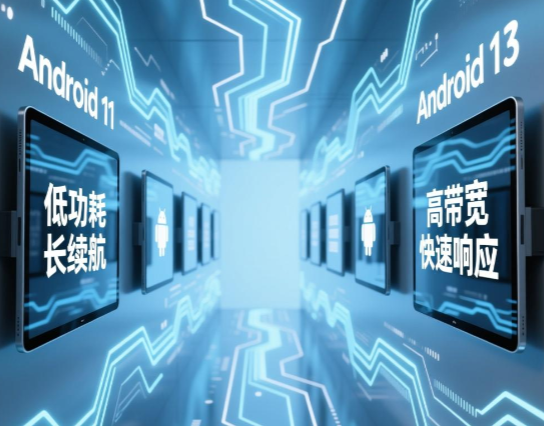
Android 11, Android 13, commercial PoE wall mount tablets
Different Android versions have their own unique features and optimizations, which make them show different advantages in adapting to the needs of commercial PoE wall mount tablets. Understanding the specific advantages of Android 11 and Android 13 in this type of device is crucial for enterprises to make reasonable procurement decisions and ensure the stable and efficient operation of business systems.
This article will conduct an in-depth analysis of the advantages of Android 11 and Android 13 for commercial PoE wall mount tablets. First, it will introduce the application status of commercial PoE wall mount tablets and the core requirements for operating systems. Then, it will technically explain the functional characteristics of Android 11 and Android 13, and compare their adaptability to commercial PoE wall mount tablets. Further, it will discuss the commercial impact of choosing different Android versions, including operation and maintenance costs, system stability, and business expansion capabilities. Finally, it will verify the practical application effects through typical cases and summarize the applicable scenarios of the two versions.
With the continuous upgrading of commercial intelligent equipment, the requirements for operating systems are becoming more and more refined. Clarifying the advantages of Android 11 and Android 13 in commercial PoE wall mount tablets can help enterprises select the most suitable operating system according to their actual business needs, maximize the value of the equipment, and promote the optimization and upgrading of commercial intelligent systems.
- Introduction
1.1 Application Scenarios and Core Requirements of Commercial PoE Wall Mount Tablets
Commercial PoE wall mount tablets have become an important part of modern commercial intelligent systems. They rely on the convenience of PoE power supply to achieve stable operation without additional power lines, and are widely used in office meeting room scheduling, retail store information release, public service hall self-service inquiry and other scenarios.
In these application scenarios, commercial PoE wall mount tablets have clear core requirements for operating systems. First, high stability is required to ensure 24/7 continuous operation without crashes or freezes. Second, strong security is needed to prevent data leakage and malicious attacks, especially when involving user information and business data. Third, good compatibility is necessary to seamlessly connect with various hardware devices and software systems. Fourth, simple and efficient operation and maintenance capabilities are required to reduce the workload of enterprise IT teams.
1.2 The Importance of Android Version Selection for Commercial PoE Wall Mount Tablets
As the core of commercial PoE wall mount tablets, the operating system directly determines the overall performance of the device. Different Android versions have obvious differences in kernel optimization, security mechanisms, and functional expansions. The rational selection of Android versions can make the tablets better adapt to commercial application scenarios and exert maximum performance.
Unreasonable version selection may lead to a series of problems, such as poor system stability, frequent failures, insufficient security protection, and difficulty in adapting to new business needs. These problems will not only affect the normal progress of business but also increase the operation and maintenance costs of enterprises. Therefore, in-depth analysis of the advantages of Android 11 and Android 13 in commercial PoE wall mount tablets has important practical significance.
- Technical Explanation of Android 11 and Android 13
2.1 Core Technical Features of Android 11
Android 11 has made targeted optimizations in terms of system stability and resource management, which is well adapted to the long-term continuous operation needs of commercial PoE wall mount tablets. Its kernel-level resource scheduling mechanism can effectively allocate CPU, memory, and other resources, ensuring that the system runs smoothly even when multiple applications are running at the same time.
In terms of hardware compatibility, Android 11 has good support for various peripheral devices commonly used in commercial scenarios, such as card readers, printers, and sensors. This compatibility ensures that commercial PoE wall mount tablets can easily integrate into existing commercial intelligent systems without additional driver development, reducing the difficulty of system deployment.
Android 11 also introduces a more flexible permission management mechanism, which can accurately control the permissions of applications, preventing unauthorized access to device hardware and data. This mechanism provides a basic security guarantee for commercial PoE wall mount tablets in scenarios involving sensitive information.
2.2 Core Technical Features of Android 13
Android 13 focuses on optimizing security performance and user experience, and has obvious advantages in dealing with complex commercial security risks. It has strengthened the encryption of data transmission and storage, and all data interactions between applications and between applications and the system are encrypted, effectively preventing data leakage during transmission and storage.
In terms of display effect optimization, Android 13 has made improvements in color management and display adaptation, which can better match the LCD IPS panel of commercial PoE wall mount tablets. This improvement makes the display content of the tablets more vivid and clear, enhancing the information transmission effect in scenarios such as information release and self-service inquiry.
Android 13 also optimizes the power management of the system. For commercial PoE wall mount tablets that use PoE power supply, this optimization can further improve energy efficiency, reduce power consumption, and reduce the long-term operation costs of enterprises. At the same time, its optimized wake-up mechanism can make the device respond faster to user operations.
2.3 Comparative Analysis of Adaptability to Commercial PoE Wall Mount Tablets
In terms of stability, Android 11 has been verified by a large number of practical applications, and its stability in long-term continuous operation is relatively reliable, which is suitable for commercial scenarios that require the device to run stably for a long time without frequent maintenance. Android 13, as a later version, inherits the stable foundation of the previous version and further optimizes the system fault tolerance, which can better handle unexpected exceptions and reduce the probability of system crashes.
In terms of security, Android 13 has obvious advantages. Its enhanced encryption mechanism and security verification process can better resist emerging security threats, which is more suitable for commercial scenarios with high security requirements, such as financial service halls and high-end retail stores. Android 11 can meet the basic security needs, but in the face of complex network attacks and data security risks, its protection capabilities are relatively weak.
In terms of compatibility, Android 11 has better compatibility with older hardware devices and legacy software systems, which is suitable for enterprises that need to upgrade equipment on the basis of existing systems. Android 13 has optimized compatibility with new hardware and new applications, which can give full play to the performance of new commercial PoE wall mount tablets and support more advanced business functions.
- Commercial Impact of Choosing Android 11 and Android 13
3.1 Impact on Operation and Maintenance Costs
Choosing Android 11 can effectively reduce the initial operation and maintenance costs of enterprises. Because Android 11 has been on the market for a long time, there are rich technical materials and mature solution cases. The IT team of enterprises can quickly solve the problems encountered in the use process, reducing the time and cost of problem handling.
Android 13, as a new version, has relatively few existing application cases, and the technical team may need a certain learning cycle to be proficient in its operation and maintenance. However, Android 13 has better long-term maintainability. Its optimized system structure and rich built-in tools can reduce the difficulty of later system upgrades and function expansions, and reduce the long-term operation and maintenance costs of enterprises.
3.2 Impact on System Stability and Business Continuity
The stable operation of commercial PoE wall mount tablets is directly related to the continuity of business. Android 11 has been fully tested in various commercial scenarios, and its stability has been widely recognized. Choosing Android 11 can ensure that the device runs stably for a long time, reduce the occurrence of business interruptions caused by system failures, and ensure the smooth progress of business.
Android 13 further improves the system stability on the basis of Android 11, especially in dealing with complex multi-tasking and high-load operations. For commercial scenarios with high real-time requirements, such as real-time data monitoring and intelligent control, Android 13 can better ensure the real-time and accuracy of data processing, providing a more reliable guarantee for business continuity.
3.3 Impact on Business Expansion Capabilities
With the development of commercial intelligence, enterprises have increasing demands for the expansion of commercial PoE wall mount tablet functions. Android 13 supports more new technologies and new functions, such as better integration with the Internet of Things and artificial intelligence, which can help enterprises quickly expand business functions and realize the upgrading of intelligent business systems.
Android 11 has certain limitations in supporting new technologies. Although some functions can be realized through third-party software, the integration effect and operation efficiency are not as good as Android 13. For enterprises that do not have high requirements for new functions and focus on the stability of existing business, Android 11 can fully meet the needs. For enterprises that need to continuously expand business functions and pursue technological innovation, Android 13 is a more suitable choice.
- Typical Use Cases
4.1 Android 11 Application in Office Building Meeting Room Scheduling System
A large office building in a central city needs to deploy commercial PoE wall mount tablets in 50 meeting rooms to realize the functions of meeting room booking, schedule display, and equipment control. The building management team pays more attention to the stability of the system and the compatibility with the existing office system.
After in-depth investigation, the management team chose commercial PoE wall mount tablets equipped with Android 11. Android 11’s good compatibility ensures that the tablets can seamlessly connect with the existing office calendar system and intelligent equipment control system. Its stable operation performance ensures that the meeting room scheduling system runs continuously 24 hours a day, without failures such as system crashes.
Since the deployment, the meeting room scheduling system has operated stably for more than a year, with no business interruptions caused by system failures. Employees can quickly complete meeting room bookings through the tablets, and the management team can easily monitor the use of meeting rooms. The operation and maintenance team said that the problems encountered in the use process can be quickly solved through existing technical materials, and the operation and maintenance cost is lower than expected.
4.2 Android 13 Application in High-End Retail Store Intelligent Display System
A high-end luxury retail chain plans to upgrade the information display system in its stores. It needs to use commercial PoE wall mount tablets to display product information, promotional activities, and store navigation. The chain pays high attention to the security of user information and the display effect of the system.
The retail chain chose commercial PoE wall mount tablets equipped with Android 13. Android 13’s enhanced data encryption mechanism ensures that the user information collected by the tablets (such as customer flow statistics data) is not leaked. Its optimized display adaptation function makes the product pictures and videos displayed on the LCD IPS panel of the tablets more vivid and clear, enhancing the customer’s viewing experience.
After the system is put into use, the display effect of the retail stores has been significantly improved, and customers’ interest in product information has increased obviously. At the same time, the security of user data has been effectively guaranteed, and there is no data leakage incident. The retail chain plans to promote this system to more stores, relying on Android 13’s good business expansion capabilities to add functions such as customer preference analysis in the later stage.
4.3 Comparative Application of Android 11 and Android 13 in Public Service Hall Self-Service System
A municipal public service hall has 30 self-service service windows, which need to use commercial PoE wall mount tablets to provide citizens with services such as certificate handling inquiry, form printing, and appointment registration. The service hall has both existing legacy systems and needs to connect new intelligent verification equipment, so it deployed tablets equipped with Android 11 and Android 13 respectively.
The windows connected to the legacy system use tablets equipped with Android 11, which ensures the smooth connection with the legacy system and the stable operation of basic services. The windows connected to the new intelligent verification equipment use tablets equipped with Android 13, which can better integrate with the new equipment and realize functions such as face recognition verification and electronic document signing.
After a period of operation, the service hall found that the tablets equipped with Android 11 ran stably in the basic service windows, with low failure rate and convenient operation and maintenance. The tablets equipped with Android 13 in the new service windows had good compatibility with new equipment, and the new functions were well received by citizens. This mixed deployment mode not only ensures the stability of existing services but also meets the needs of new service expansion.
- Conclusion
Android 11 and Android 13 have their own unique advantages for commercial PoE wall mount tablets, and their applicable scenarios are different. Android 11 has obvious advantages in system stability, compatibility with legacy systems, and low initial operation and maintenance costs, which is more suitable for enterprises that focus on the stability of existing business and need to connect with legacy systems.
Android 13 shows greater advantages in security performance, display effect optimization, and business expansion capabilities. It can better adapt to commercial scenarios with high security requirements and the need for continuous technological upgrading, helping enterprises realize the innovation and development of intelligent business systems.
The choice between Android 11 and Android 13 should not be simply based on the new and old versions, but should be comprehensively considered according to the actual business needs of enterprises, the status of existing systems, and long-term development plans. Enterprises need to clarify their core requirements for commercial PoE wall mount tablets, such as stability, security, or expandability, so as to select the most suitable Android version.
With the continuous development of commercial intelligent technology, the functions of Android system will be further optimized and improved. Whether it is Android 11 or Android 13, they will continue to play an important role in the application of commercial PoE wall mount tablets. For manufacturers of commercial PoE wall mount tablets, it is necessary to develop products adapted to different Android versions according to market needs, and provide more targeted solutions for enterprises.
In summary, Android 11 and Android 13 have their own irreplaceable advantages for commercial PoE wall mount tablets. Rational selection according to actual needs can maximize the value of the equipment, promote the efficient operation of business, and help enterprises achieve better development in the process of digital transformation.


Leave a Reply
You must be logged in to post a comment.