

Why is Linux (Debian/Ubuntu) more suitable for industrial control wall mount tablets than Android?
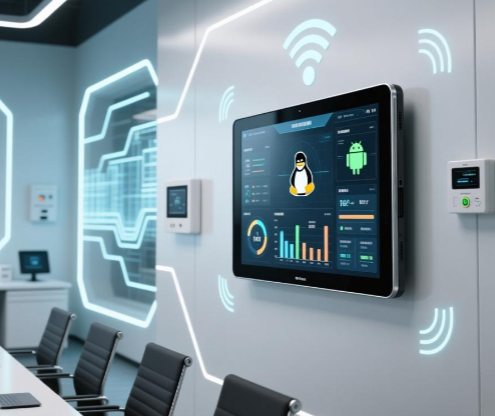
Linux Debian Ubuntu, industrial control wall mount tablets, LCD IPS panel
The choice of operating system directly affects the overall performance and operational reliability of industrial control wall mount tablets. While Android is widely used in commercial and consumer electronic devices, it often struggles to fully meet the specialized needs of industrial control environments. In contrast, Linux distributions such as Debian and Ubuntu exhibit unique advantages in adapting to the harsh and complex industrial control scenarios.
This article will explore the reasons why Linux Debian Ubuntu is more suitable for industrial control wall mount tablets than Android. It will first introduce the application status of industrial control wall mount tablets and the core requirements for operating systems in industrial control scenarios. Then, it will conduct in-depth technical comparisons between Linux Debian Ubuntu and Android, focusing on aspects such as system architecture, stability, security and customizability.
Further, it will analyze the commercial impacts brought by choosing Linux Debian Ubuntu for industrial control wall mount tablets, including operational efficiency improvement, maintenance cost reduction and risk mitigation. Practical application values will be verified through typical cases in different industrial fields. Finally, a summary will be given on the applicability of Linux Debian Ubuntu in industrial control wall mount tablets and its development prospects.
Understanding the advantages of Linux Debian Ubuntu over Android in industrial control scenarios is crucial for enterprises to select appropriate operating systems for industrial control wall mount tablets. It also provides valuable references for manufacturers to develop products that better cater to industrial control needs, promoting the modernization and intelligence of industrial control systems.
- Introduction
1.1 Application Scenarios of Industrial Control Wall Mount Tablets
Industrial control wall mount tablets have been widely applied in various industrial fields, playing irreplaceable roles in optimizing production processes, improving operational efficiency and ensuring production safety. In automated production lines, these tablets are used to monitor the operating status of each production unit in real time, issue control commands and adjust production parameters according to actual operating conditions.
In intelligent manufacturing workshops, industrial control wall mount tablets serve as human-machine interaction terminals, enabling workers to set production tasks, query production data and manage workshop resources. In industrial monitoring systems, they are deployed in key areas to display real-time monitoring images, collect environmental data such as temperature and humidity, and trigger early warnings in case of abnormal conditions. The diversity and complexity of these application scenarios place high demands on the operating systems of the tablets.
1.2 Core Requirements for Operating Systems in Industrial Control Scenarios
Industrial control scenarios have distinct core requirements for operating systems of wall mount tablets, which are significantly different from consumer scenarios. Firstly, ultra-high stability is required, as industrial control systems often need to run continuously for a long time, even for several years, without system crashes or malfunctions that could lead to production interruptions.
Secondly, strong security is essential. Industrial control systems involve core production data and equipment control commands, which are vulnerable to malicious attacks that could cause serious economic losses and safety hazards. Therefore, the operating system must have robust security mechanisms to resist various network attacks and data breaches.
Thirdly, high customizability is needed. Different industrial fields and even different enterprises have unique process requirements, so the operating system should support deep customization to adapt to specific application scenarios and functional needs. Finally, good compatibility with industrial hardware and protocols is required to seamlessly connect with various industrial sensors, controllers and other equipment.
- Technical Explanation: Comparison Between Linux (Debian/Ubuntu) and Android
2.1 System Architecture Differences
Linux Debian Ubuntu adopts a modular and lightweight system architecture, which allows for flexible configuration according to actual needs. Users can select and install only the necessary system components and services, reducing system resource occupation and minimizing potential points of failure. This architecture is particularly suitable for industrial control wall mount tablets that often have limited hardware resources and require focused operation on specific tasks.
Android, on the other hand, is based on a Linux kernel but has added a large number of components and services for consumer scenarios, such as multimedia playback, social application support and user experience optimization. These additional components not only occupy more system resources but also increase the complexity of the system, making it difficult to achieve the streamlined operation required by industrial control scenarios.
Moreover, the system update mechanism of Linux Debian Ubuntu is more stable and controllable. Enterprises can choose to freeze the system version according to their needs, avoiding the impact of unexpected updates on the stable operation of industrial control systems. In contrast, Android’s update mechanism is more oriented to consumer needs, with frequent updates that may introduce compatibility issues with industrial control software and hardware.
2.2 Stability Comparison
Linux Debian Ubuntu is renowned for its excellent long-term stability, which is a key advantage in industrial control scenarios requiring 24/7 continuous operation. The system has undergone long-term practice and optimization, with mature kernel and component designs that can effectively reduce the probability of system crashes and freezes.
In industrial control environments, factors such as voltage fluctuations, electromagnetic interference and high-temperature operation can easily affect the stability of electronic devices. Linux Debian Ubuntu has strong anti-interference capabilities and can maintain stable operation even in harsh environmental conditions. It also supports automatic recovery mechanisms for unexpected situations, ensuring that the system can quickly resume normal operation after temporary faults.
Android, designed initially for consumer devices, has relatively poor long-term stability. Its system resources are easily occupied by background processes and applications, leading to gradual performance degradation during long-term operation. In addition, Android’s dependence on hardware drivers and third-party libraries increases the risk of system instability in complex industrial environments, which may result in production interruptions and economic losses.
2.3 Security Performance Analysis
Security is a critical factor in industrial control scenarios, and Linux Debian Ubuntu has obvious advantages in this regard. The system adopts a strict permission management mechanism, which accurately controls the access rights of applications and processes to system resources, effectively preventing unauthorized operations and data access.
Linux Debian Ubuntu also has a perfect security update and patch mechanism. The open-source nature of the system allows global developers to participate in security testing and vulnerability repair, ensuring that security vulnerabilities can be discovered and fixed in a timely manner. Enterprises can also customize security policies according to their specific needs, further enhancing the system’s security defense capabilities.
In contrast, Android has inherent security risks due to its open ecosystem and consumer-oriented design. The large number of third-party applications in the Android ecosystem increases the risk of malware intrusion. Although Android has continuously strengthened its security mechanisms in recent versions, it still faces challenges in resisting targeted attacks in industrial control scenarios. Moreover, the fragmentation of Android versions makes it difficult to ensure that all devices can receive timely security updates, leaving potential security loopholes.
2.4 Customizability and Scalability
Linux Debian Ubuntu offers extremely high customizability, which is well-suited to the diverse needs of industrial control scenarios. Enterprises can conduct deep customization of the system kernel, drivers and application layers according to their specific industrial control processes and equipment requirements, removing unnecessary components and adding specialized functions.
This customization capability enables Linux Debian Ubuntu to perfectly adapt to various special industrial control tasks, such as real-time data processing, precise equipment control and custom protocol support. In addition, the rich software libraries and development tools of Linux Debian Ubuntu provide strong support for secondary development, facilitating enterprises to develop personalized industrial control applications.
Android’s customizability is relatively limited, as it is constrained by Google’s unified system framework and certification requirements. Although some deep customizations can be achieved through modified ROMs, the process is complex and may affect the system’s stability and compatibility. Moreover, Android’s application development is mainly oriented to consumer scenarios, and the support for industrial control-specific functions and protocols is insufficient, making it difficult to meet the personalized needs of industrial control applications.
2.5 Compatibility with Industrial Hardware and Protocols
Linux Debian Ubuntu has excellent compatibility with various industrial hardware and communication protocols, which is a key factor in its wide application in industrial control fields. The system supports a variety of industrial buses and interfaces, such as Modbus, CANopen and Ethernet/IP, enabling seamless connection with industrial sensors, PLCs, inverters and other equipment.
For industrial control wall mount tablets equipped with LCD IPS panels, Linux Debian Ubuntu can provide more precise display control, ensuring clear and stable display of industrial control interface elements and data. The system’s driver support for industrial-grade hardware is also more comprehensive, reducing the difficulty of hardware integration and shortening the product development cycle.
Android’s compatibility with industrial hardware and protocols is relatively weak. It is mainly optimized for consumer-grade hardware, and the support for industrial-specific hardware and protocols often requires additional development of drivers and middleware. This not only increases the development cost and cycle but also may affect the stability and reliability of the system’s operation in industrial control scenarios.
- Commercial Impact of Choosing Linux (Debian/Ubuntu) for Industrial Control Wall Mount Tablets
3.1 Improvement of Operational Efficiency and Production Stability
Choosing Linux Debian Ubuntu for industrial control wall mount tablets can significantly improve the operational efficiency of industrial control systems and enhance production stability. The excellent stability of Linux Debian Ubuntu ensures long-term continuous operation of industrial control wall mount tablets, reducing production interruptions caused by system failures.
The real-time performance and efficient data processing capabilities of the system enable industrial control wall mount tablets to quickly respond to equipment control commands and accurately collect and analyze production data. This helps enterprises optimize production processes, improve production efficiency and reduce product defect rates. In addition, the good compatibility of Linux Debian Ubuntu with industrial equipment ensures the smooth operation of the entire industrial control system, further enhancing production stability.
3.2 Reduction of Maintenance Costs and Total Ownership Costs
Adopting Linux Debian Ubuntu can effectively reduce the maintenance costs and total ownership costs of industrial control wall mount tablets. The stability of the system reduces the frequency of system failures and the need for maintenance, thereby reducing maintenance labor costs and downtime losses.
The open-source nature of Linux Debian Ubuntu means that enterprises do not need to pay high licensing fees, reducing the initial investment cost. Moreover, the rich technical documentation and active community support of Linux Debian Ubuntu enable maintenance personnel to quickly solve problems encountered during operation, shortening the maintenance time and reducing maintenance costs. In contrast, Android requires payment of relevant licensing fees for commercial use, and its maintenance is more complex due to version fragmentation, leading to higher long-term maintenance costs.
3.3 Mitigation of Operational Risks and Enhancement of Risk Control Capabilities
The strong security performance of Linux Debian Ubuntu helps enterprises mitigate operational risks associated with industrial control wall mount tablets. The strict permission management and timely security updates of the system can effectively prevent malicious attacks and data breaches, protecting core production data and equipment safety.
In industrial control scenarios, system failures or security breaches may lead to serious consequences such as production suspension, equipment damage and even safety accidents. By choosing Linux Debian Ubuntu, enterprises can enhance the risk control capabilities of their industrial control systems, reduce the probability of adverse events and ensure the smooth progress of production operations. This is particularly important for industries with high-risk coefficients such as petroleum, chemical and power generation.
3.4 Promotion of Technological Innovation and Sustainable Development
The high customizability and scalability of Linux Debian Ubuntu provide a favorable platform for enterprises to carry out technological innovation based on industrial control wall mount tablets. Enterprises can develop innovative industrial control functions and applications according to their own development needs, promoting the upgrading of industrial control systems and the transformation to intelligent manufacturing.
The open-source ecosystem of Linux Debian Ubuntu also facilitates enterprises to cooperate with upstream and downstream enterprises and research institutions, sharing technical resources and promoting technological progress. This helps enterprises maintain technological competitiveness in the fierce market competition and achieve sustainable development.
- Typical Use Cases
4.1 Application in Automated Production Lines of Automobile Manufacturing
A large automobile manufacturing enterprise needed to upgrade the control system of its automated welding production line, requiring industrial control wall mount tablets to monitor the operation status of welding robots in real time, collect welding parameter data and issue control commands. The enterprise had strict requirements for the stability and real-time performance of the system, as well as high security requirements for production data.
After in-depth evaluation, the enterprise chose industrial control wall mount tablets pre-installed with Debian, a Linux distribution. Debian’s stable system architecture ensured that the tablets could run continuously for 24 hours a day, 365 days a year, without system crashes. Its excellent real-time performance enabled the tablets to quickly respond to the operation data of welding robots and issue control commands in a timely manner, ensuring the accuracy and stability of the welding process.
The strict security mechanism of Debian effectively protected the core production data such as welding parameters from being leaked or tampered with. In addition, the enterprise customized the system according to the characteristics of the welding production line, adding specialized data analysis modules to optimize welding parameters. Since the deployment, the automated welding production line has operated stably for more than two years, with the failure rate reduced by 45% compared with the previous system, and the production efficiency increased by 20%.
4.2 Application in Intelligent Monitoring Systems of Chemical Plants
A chemical plant needed to deploy industrial control wall mount tablets in multiple production workshops to monitor environmental parameters such as temperature, pressure and gas concentration in real time, and trigger alarms and control related equipment in case of abnormal conditions. The chemical plant required the system to have strong anti-interference capabilities and high reliability, as well as good compatibility with various industrial sensors and alarm devices.
The plant selected industrial control wall mount tablets equipped with Ubuntu, a Linux distribution. Ubuntu’s excellent compatibility enabled the tablets to seamlessly connect with various types of industrial sensors and alarm devices used in the plant, realizing real-time collection and display of environmental parameters. Its strong anti-interference capabilities ensured that the system could operate stably in the harsh environment of the chemical plant with strong electromagnetic interference and large temperature fluctuations.
The enterprise also customized the security policies of Ubuntu according to the characteristics of the chemical industry, enhancing the protection of monitoring data and control commands. Since the deployment of the system, the chemical plant has successfully prevented three potential safety accidents by virtue of the timely alarm and rapid response capabilities of the industrial control wall mount tablets. The system’s stable operation has been highly recognized by the plant’s management, and it has been promoted to other production workshops.
4.3 Application in Intelligent Manufacturing Workshops of Electronic Components
A manufacturer of electronic components built an intelligent manufacturing workshop, requiring industrial control wall mount tablets to serve as human-machine interaction terminals, realizing functions such as production task assignment, equipment status query and production data statistics. The manufacturer needed the system to support secondary development to adapt to its unique production process and management needs, and also required low long-term maintenance costs.
The manufacturer chose industrial control wall mount tablets installed with Linux Debian. Taking advantage of Debian’s high customizability, the manufacturer carried out secondary development on the system, adding personalized modules such as production task scheduling and quality traceability. These modules were perfectly integrated with the enterprise’s existing MES system, realizing the seamless connection of production data.
Debian’s open-source nature saved the manufacturer a lot of licensing fees, and its rich technical documentation and community support made the maintenance work simple and efficient. The maintenance team could quickly solve problems encountered during operation through community resources. Since the application, the intelligent manufacturing workshop’s production management efficiency has been significantly improved, the time for task assignment reduced by 30%, and the production data statistics accuracy reached 99.8%. The long-term maintenance cost was 35% lower than the expected cost of using Android-based tablets.
- Conclusion
Linux Debian Ubuntu is more suitable for industrial control wall mount tablets than Android, mainly due to its unique advantages in system stability, security, customizability and compatibility with industrial scenarios. These advantages enable Linux Debian Ubuntu to perfectly meet the core requirements of industrial control scenarios for operating systems, providing a reliable technical support for the stable and efficient operation of industrial control wall mount tablets.
From a technical perspective, Linux Debian Ubuntu’s modular architecture, strict permission management and perfect customization capabilities make it more adaptable to the complex and harsh industrial control environment. Its excellent compatibility with industrial hardware and protocols ensures the smooth integration of industrial control wall mount tablets with the entire industrial control system, while its stable operation performance guarantees long-term continuous work without failures.
Commercially, choosing Linux Debian Ubuntu for industrial control wall mount tablets can help enterprises improve operational efficiency, reduce maintenance costs, mitigate operational risks and enhance technological innovation capabilities. These commercial benefits are crucial for enterprises to improve market competitiveness and achieve sustainable development in the field of intelligent manufacturing.
The typical use cases in automobile manufacturing, chemical plants and electronic component production fully verify the practical value of Linux Debian Ubuntu in industrial control wall mount tablets. It can effectively solve the problems faced by Android in industrial control scenarios and bring tangible benefits to enterprises.
Looking to the future, with the continuous development of intelligent manufacturing and industrial Internet of Things technologies, the requirements of industrial control scenarios for operating systems will become more stringent. Linux Debian Ubuntu, with its open-source advantages and continuous optimization, will further enhance its adaptability and competitiveness in industrial control wall mount tablets. It is expected to be widely applied in more industrial fields, promoting the upgrading and transformation of the global industrial control industry.
In summary, the advantages of Linux Debian Ubuntu in stability, security, customizability and compatibility make it a more ideal choice for industrial control wall mount tablets than Android. For enterprises engaged in industrial control, choosing Linux Debian Ubuntu as the operating system for industrial control wall mount tablets is of great significance for improving the level of industrial control and promoting the development of intelligent manufacturing.


Leave a Reply
You must be logged in to post a comment.