

How do wall mount tablets realize seamless integration with smart home IoT devices?
Wall mount tablet & smart home IoT integration has become a key demand in the smart home ecosystem. Wall mount tablets equipped with LCD IPS panels serve as important interactive terminals, connecting various smart home IoT devices to achieve unified control and management. The realization of this integration not only optimizes the user experience of smart homes but also promotes the intelligent upgrading of living environments. Exploring how wall mount tablets achieve wall mount tablet & smart home IoT integration is of great significance for both users and the smart home industry.
This article focuses on wall mount tablet & smart home IoT integration, elaborating on the relevant technical principles, implementation paths, commercial value and typical application scenarios. It starts with an overview of the application status of wall mount tablets in smart home IoT integration, then conducts in-depth technical explanation on the core technologies and implementation steps of seamless integration, discusses the commercial impact brought by successful integration, lists typical application scenarios to reflect the practical value of integration, and finally summarizes the development trend and related suggestions of this field.
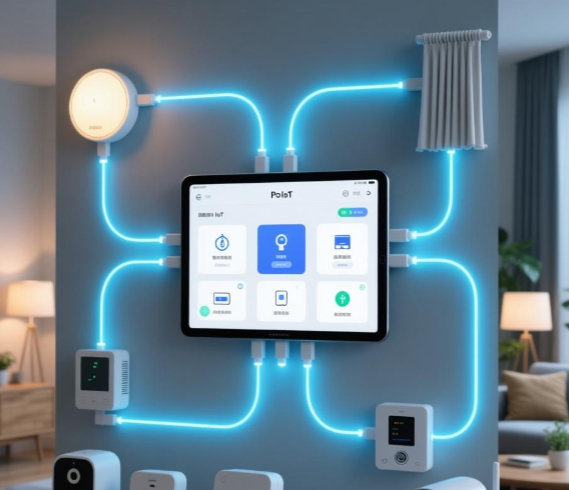
Wall mount tablet & smart home IoT integration, Seamless IoT device connection, Smart home control terminal adaptation
- Introduction
1.1 Application Status of Wall Mount Tablet & Smart Home IoT Integration
With the rapid development of the Internet of Things technology, smart homes have gradually entered thousands of households. Wall mount tablets, as visual and interactive core devices, are increasingly used in smart home IoT integration. These devices rely on their high-definition LCD IPS panels to display the working status of various smart home devices in real time, and users can realize remote control and scene linkage of devices through touch operation.
At present, more and more smart home systems take wall mount tablets as the central control terminal. They connect with smart lighting, smart curtains, smart air conditioners, smart security devices and other IoT devices to form a comprehensive smart home management system. The application of wall mount tablet & smart home IoT integration not only simplifies the operation process of smart devices but also enhances the coordination and intelligence of the entire home system.
1.2 Significance of Wall Mount Tablet & Smart Home IoT Integration
For users, wall mount tablet & smart home IoT integration brings a more convenient and comfortable living experience. Users no longer need to operate multiple independent control terminals for different smart devices. Through a single wall mount tablet, they can complete the control of all connected IoT devices, realizing one-stop management of smart homes. The clear display effect of the LCD IPS panel also makes the status of each device intuitive and easy to understand, reducing the learning cost of using smart devices.
For the smart home industry, the integration of wall mount tablets and smart home IoT devices promotes the standardization and integration of the industry. It drives manufacturers to pay more attention to the compatibility and interoperability of products, promoting the formation of a more unified technical standard system in the industry. At the same time, this integration also expands the application scenarios of wall mount tablets, promoting the innovation and development of related products and technologies.
1.3 Research Focus of This Article
This article focuses on the key issues of how wall mount tablets realize seamless integration with smart home IoT devices. It will explore the core technologies required for integration, the specific implementation paths, and the factors that affect the integration effect. At the same time, it will analyze the commercial value brought by successful integration and the typical application scenarios, providing reference for users who want to build smart home systems and related industry practitioners.
- Technical Explanation
2.1 Core Technologies for Wall Mount Tablet & Smart Home IoT Integration
The first core technology is wireless communication technology. Wall mount tablets usually adopt multiple wireless communication protocols to connect with different smart home IoT devices. Common protocols include Wi-Fi, Bluetooth, Zigbee and Z-Wave. Each protocol has its own characteristics and applicable scenarios. For example, Wi-Fi is suitable for devices that require high-speed data transmission, such as smart cameras; Zigbee has the advantages of low power consumption and large network capacity, which is suitable for small sensor devices such as smart door sensors and smart window sensors.
The second core technology is the integration of operating systems and application software. Wall mount tablets need to be equipped with a professional smart home control system that can manage and coordinate various connected IoT devices uniformly. The system should have good compatibility, supporting devices of different brands and protocols. At the same time, the application software on the tablet should have a user-friendly interface. The LCD IPS panel can display the operation interface and device status clearly, allowing users to operate easily.
The third core technology is data processing and analysis technology. During the integration process, wall mount tablets will collect a large amount of data from smart home IoT devices, such as device working status, user operation habits and environmental parameters. Through data processing and analysis, the tablet can realize intelligent scene linkage, such as automatically adjusting the brightness of smart lights according to the indoor light intensity, and adjusting the temperature of the air conditioner according to the user’s usual habits.
2.2 Implementation Paths of Seamless Integration
The first implementation path is through a unified cloud platform. Wall mount tablets connect to the cloud platform through the Internet, and smart home IoT devices also access the same cloud platform. The cloud platform is responsible for data transmission and command forwarding between the tablet and the devices. This path has the advantage of remote control. Users can control the smart home devices at home through the wall mount tablet even when they are outside, as long as there is a network connection.
The second implementation path is local area network connection. Wall mount tablets and smart home IoT devices are in the same local area network, and data transmission is carried out directly through the local network without going through the cloud. This path has the advantages of low latency and high stability. Even in the case of poor network conditions or network disconnection, the basic control functions of the smart home system can still be guaranteed. It is suitable for scenarios that require real-time control, such as smart security systems.
The third implementation path is the combination of cloud and local area network. This path combines the advantages of the first two paths. Under normal network conditions, it uses the cloud platform to realize remote control and data backup; when the network is disconnected, it automatically switches to the local area network connection to ensure the normal operation of the system. This path improves the reliability and stability of the integration system, providing users with a more comprehensive use experience.
2.3 Key Steps for Realizing Integration
The first step is device discovery and access. Wall mount tablets need to automatically discover smart home IoT devices in the surrounding environment through built-in wireless communication modules. After discovering the devices, the tablet will send an access request to the devices. After the user confirms the authorization, the devices can be successfully added to the smart home control system of the tablet. This step requires the tablet to have good device recognition capabilities and compatibility.
The second step is protocol conversion and adaptation. Due to the different communication protocols used by different smart home IoT devices, wall mount tablets need to complete protocol conversion and adaptation work. The tablet’s control system will convert the data and commands of different protocols into a unified format, so that it can communicate and interact with various devices smoothly. This step is the key to ensuring the compatibility of the entire integration system.
The third step is interface customization and function integration. After the devices are successfully accessed, wall mount tablets need to customize the display interface and control functions according to the characteristics and functions of each device. For example, for smart lighting devices, the interface will display options such as switch status and brightness adjustment; for smart air conditioners, it will display temperature, mode and other parameters. The LCD IPS panel can present these interfaces clearly, and users can complete the control of the devices through touch operations.
The fourth step is scene setting and linkage configuration. Users can set different smart home scenes through the wall mount tablet, such as “home mode”, “sleep mode” and “away mode”. In each scene, the working status of multiple devices can be set. For example, in “sleep mode”, the smart lights are turned off, the curtains are closed, and the air conditioner is adjusted to a suitable temperature. The tablet will realize the automatic linkage of the devices according to the set scenes, improving the intelligence of the smart home system.
2.4 Factors Affecting Integration Effect
The first factor is the compatibility of devices and protocols. If the smart home IoT devices use non-standard communication protocols or have poor compatibility, it will be difficult to realize seamless integration with wall mount tablets. Therefore, when building a smart home system, it is necessary to choose devices that support mainstream communication protocols and have good compatibility.
The second factor is the performance of the wall mount tablet. The processing speed, storage capacity and wireless communication capability of the tablet will directly affect the integration effect. A tablet with strong performance can handle a large number of device connection and data transmission tasks more smoothly, avoiding problems such as lag and stuck during use. The quality of the LCD IPS panel also affects the user’s operation experience. A high-definition and high-brightness panel can make the interface display clearer and the touch operation more sensitive.
The third factor is network stability. Whether it is cloud platform connection or local area network connection, network stability is an important guarantee for the normal operation of the integration system. Poor network quality will lead to delayed data transmission, failed command execution and other problems, affecting the user’s use experience. Therefore, it is necessary to ensure the stability of the home network when realizing the integration of wall mount tablets and smart home IoT devices.
- Commercial Impact
3.1 Impact on Smart Home Industry Development
Wall mount tablet & smart home IoT integration promotes the transformation and upgrading of the smart home industry. It makes the smart home system from a single device combination to an integrated intelligent ecosystem, improving the overall added value of the industry. Manufacturers are no longer limited to the production and sales of individual smart devices, but begin to focus on the research and development of integrated solutions, promoting the industrial chain to extend to the high-end service field.
This integration also intensifies the competition in the smart home market. Manufacturers who can provide more stable, convenient and intelligent wall mount tablet integration solutions will have more market advantages. In order to gain competitive advantages, manufacturers will increase investment in technology research and development, promoting the continuous progress of wireless communication technology, data processing technology and other related technologies. This will drive the continuous development of the entire smart home industry in the direction of intelligence, networking and integration.
3.2 Impact on Wall Mount Tablet Market Demand
The popularity of wall mount tablet & smart home IoT integration has significantly boosted the market demand for wall mount tablets. Traditional wall mount tablets are mainly used for information display and simple interaction, while wall mount tablets for smart home integration have higher performance requirements and more abundant functions. They need to have strong wireless communication capabilities, good compatibility and a professional smart home control system.
In order to meet the demand of smart home integration, manufacturers have launched a series of special wall mount tablets. These tablets are equipped with high-performance processors, high-definition LCD IPS panels and multiple wireless communication modules, which are specially designed for smart home scenarios. The increase in market demand has promoted the expansion of the wall mount tablet market scale and driven the innovation and upgrading of related products.
3.3 Impact on User Consumption Choices
Wall mount tablet & smart home IoT integration has changed users’ consumption choices in the smart home field. When purchasing smart home devices, users are no longer limited to the functions and quality of individual devices, but pay more attention to whether the devices can be seamlessly integrated with the wall mount tablet control system. Devices with good compatibility and strong integration capabilities are more likely to be favored by users.
This change has also prompted users to pay more attention to the overall planning of the smart home system when building a smart home. They will choose a unified brand or a unified platform of wall mount tablets and smart devices to ensure the seamless integration of the entire system. This not only reduces the trouble of later use but also improves the overall user experience of the smart home system.
3.4 Impact on Related Service Industries
The development of wall mount tablet & smart home IoT integration has driven the development of related service industries. The first is the installation and debugging service industry. The integration of wall mount tablets and smart home IoT devices requires professional installation and debugging to ensure the normal operation of the system. This has created a large number of jobs for the installation and debugging service industry and promoted the professionalization of the industry.
The second is the after-sales service industry. Due to the complexity of the integrated system, users may encounter various problems during use, which requires professional after-sales service support. After-sales service providers need to have a comprehensive understanding of the integration technology of wall mount tablets and smart home devices to provide timely and effective solutions for users. This has promoted the upgrading and development of the after-sales service industry.
In addition, the integration has also driven the development of the smart home system customization service industry. Different users have different needs for smart homes. Some users need to customize personalized scene modes and control functions according to their own living habits. The customization service industry can provide targeted solutions according to users’ needs, further improving the user experience of smart home integration systems.
- Typical Use Cases
4.1 Whole House Smart Control Scenario
In the whole house smart control scenario, a wall mount tablet is installed in the living room as the central control terminal. It connects with all smart devices in the house, including smart lighting, smart curtains, smart air conditioners, smart TVs, smart security cameras and smart door locks. Users can realize the on-off control, parameter adjustment and status monitoring of all devices through the wall mount tablet. The LCD IPS panel of the tablet clearly displays the working status of each device, and users can switch between different device control interfaces with a light touch.
The system can also realize automatic scene linkage. For example, when the user gets up in the morning, the wall mount tablet automatically controls the curtains to open slowly, the smart lights to turn on gradually, and the air conditioner to adjust to a comfortable temperature. When the user leaves home, the tablet automatically turns off all unnecessary electrical appliances, closes the curtains, and activates the smart security system. This scenario fully reflects the convenience and intelligence brought by wall mount tablet & smart home IoT integration.
4.2 Smart Security Monitoring Scenario
In the smart security monitoring scenario, a wall mount tablet is installed at the entrance of the house, connecting with smart security devices such as smart door sensors, smart window sensors, smart cameras and smart alarms. The tablet displays the real-time monitoring images of the cameras and the status of the door and window sensors in real time through the LCD IPS panel. When a door or window is opened abnormally, the smart sensor sends an alarm signal to the wall mount tablet immediately.
The tablet receives the signal and immediately triggers the alarm device to issue an alarm sound. At the same time, it pushes the alarm information to the user’s mobile phone. Users can view the real-time situation at home through the wall mount tablet or mobile phone and take corresponding measures. This scenario enhances the safety of the home environment and provides users with a sense of security.
4.3 Smart Lighting Control Scenario
In the smart lighting control scenario, a wall mount tablet is installed in each room, connecting with the smart lights in the room. Users can adjust the brightness, color temperature and switching status of the smart lights through the tablet. The LCD IPS panel of the tablet displays various lighting modes for users to choose from, such as reading mode, dining mode and entertainment mode. Each mode corresponds to a specific brightness and color temperature setting, which can meet the needs of users in different scenarios.
The system can also adjust the lighting according to the indoor light intensity and the user’s operation habits. For example, when the indoor light is weak, the tablet automatically increases the brightness of the smart lights; when the user leaves the room, the tablet automatically turns off the lights. This scenario not only improves the comfort of lighting but also saves energy.
4.4 Smart HVAC Control Scenario
In the smart HVAC control scenario, a wall mount tablet is installed in the living room and bedroom, connecting with smart air conditioners and smart heating equipment. Users can set the temperature, mode and wind speed of the air conditioners or heating equipment through the tablet. The LCD IPS panel displays the current temperature, set temperature and working mode of the equipment in real time, allowing users to grasp the working status of the equipment at any time.
The system can also realize intelligent temperature control according to the indoor and outdoor temperature changes and the user’s living habits. For example, before the user gets home, the tablet automatically controls the air conditioner to turn on, adjusting the indoor temperature to a comfortable level in advance. When the indoor temperature reaches the set value, the equipment automatically enters the energy-saving mode, reducing energy consumption. This scenario improves the comfort of the living environment and realizes energy saving and environmental protection.
- Conclusion
5.1 Summary of Wall Mount Tablet & Smart Home IoT Integration
Wall mount tablet & smart home IoT integration is an important development trend of the smart home industry. It relies on wireless communication technology, operating system integration technology and data processing technology to realize the seamless connection and unified control between wall mount tablets and various smart home IoT devices. The implementation paths of integration include cloud platform connection, local area network connection and the combination of cloud and local area network. Each path has its own characteristics and applicable scenarios.
The key steps to realize integration include device discovery and access, protocol conversion and adaptation, interface customization and function integration, and scene setting and linkage configuration. The integration effect is affected by factors such as device and protocol compatibility, wall mount tablet performance and network stability. Successful integration can bring convenient and comfortable living experience to users, promote the development of the smart home industry and related service industries, and boost the market demand for wall mount tablets.
5.2 Suggestions for Users
When building a smart home system based on wall mount tablet & smart home IoT integration, users should first do a good job in overall planning. They should clarify their own needs and choose the appropriate integration path and smart devices according to their living habits and housing conditions. It is recommended to choose devices that support mainstream communication protocols and have good compatibility to ensure the smooth progress of integration.
Secondly, users should choose high-performance wall mount tablets. They should pay attention to the tablet’s processor performance, storage capacity, wireless communication capability and the quality of the LCD IPS panel. A high-performance tablet can ensure the stability and smoothness of the integration system. At the same time, users should also pay attention to the user-friendliness of the tablet’s control system and application software, choosing products with simple operation and clear interface.
In addition, users should ensure the stability of the home network. They can choose high-quality routers and network equipment, and reasonably arrange the network coverage to avoid network dead ends. For important smart home devices that require real-time control, it is recommended to choose the local area network connection mode or the combination of cloud and local area network mode to ensure the reliability of the system.
5.3 Suggestions for Manufacturers
Manufacturers should strengthen the research and development of core technologies for wall mount tablet & smart home IoT integration. They should focus on improving the compatibility and interoperability of products, developing a more unified and open technical standard system. At the same time, manufacturers should increase investment in wireless communication technology and data processing technology to improve the stability and intelligence of the integration system.
In terms of product design, manufacturers should pay more attention to user needs. They should develop wall mount tablets with more humanized interfaces and more abundant functions, and optimize the quality of the LCD IPS panel to improve the user’s operation experience. Manufacturers should also launch targeted integrated solutions for different user groups and application scenarios, providing users with one-stop smart home construction services.
In addition, manufacturers should strengthen after-sales service support. They should establish a professional after-sales service team to provide users with installation and debugging, maintenance and technical consultation services. At the same time, manufacturers should collect user feedback in a timely manner, continuously optimize products and solutions, and improve user satisfaction.
5.4 Future Development Trend
The future of wall mount tablet & smart home IoT integration will show a more intelligent, personalized and integrated development trend. With the development of artificial intelligence technology, wall mount tablets will have more powerful intelligent voice interaction capabilities. Users can control smart home devices through voice commands, further simplifying the operation process.
In terms of personalization, the integration system will be more able to meet the individual needs of users. Through in-depth analysis of user behavior data, the system can automatically adjust the working status of smart devices according to the user’s living habits, providing a more personalized smart home experience. At the same time, the customization of the system will become more flexible, allowing users to freely combine and set functions according to their own needs.
In terms of integration, the scope of wall mount tablet & smart home IoT integration will be further expanded. It will not only realize the integration of home internal devices but also connect with the smart city system, realizing the interaction between home and the outside world. For example, the smart home system can automatically adjust the indoor air quality according to the outdoor air quality data, and the wall mount tablet can display the outdoor traffic information and public service information.
Premium Wall Mount Tablet Smart Home IoT Integration Guide 4


Leave a Reply
You must be logged in to post a comment.